


What is Account Planning?
Account planning is the process of building strategic plans to improve value-driven relationships with your key customers that can help in long-term development and retention, thereby maximizing the revenue potential. Effective account plans help account managers to gain a more in-depth understanding of the client.
Account Planning has been around for years. Did you know that 65% of a company’s business comes from existing customers? Or that 80% of your future profits are likely to come from 20% of current customers? In other words, building and cultivating healthy relationships with clients is one of the most effective pathways to exponential growth.
With so much at stake, it’s no wonder that 61% of companies consider strategic account management as the key to increasing revenue, profits, and customer satisfaction. While the importance of account management is unquestionable, its implementation leaves a lot to be desired even today. 71% of companies believe that sales improved by less than 26% since launching their Strategic Account Management programs.
Why is Account Planning essential for your business to grow?
A recent Account Planning Book of Evidence study surveyed 1034 people from 62 countries to determine why organizations undertake the account planning exercise. Most of the results were unsurprising:
- Better Win rate (75%)
- Increased understanding of customers’ business (72%)
- Shorter sales cycles (58%)
- Better customer loyalty (55%)
- Increased deal size (49%)
- Better executive access (47%)
- Identify non-competitive deals (27%)
While this gives us an insight into the benefits of Account Planning as a whole, it also goes to show that there is some ambiguity when it comes to defining the overall purpose of account planning. A better win rate is too vague and can apply to all key account management processes. ‘Increased understanding of customers’ business’ is important but it doesn’t talk about outcomes.
Download Now: 9 Steps to Build a Rock-Solid Key Account Management Process
Purpose of Account Planning
There are a couple of reasons why companies struggle with effective account management. The first is that technological innovation has shifted the landscape across departments and industries, and account management has also changed with it.
As a result, companies that weren’t able to keep up with changing trends in account management have suffered. Apart from technology shifts, there is another reason why some companies struggle with effective SAM (Strategic Account Management). The key to effective account management lies in sound Account Planning. Many companies either ignore account planning or do account planning for the sake of it, without a clear understanding of its purpose and expected outcomes.
Without effective account planning, account managers are simply unable to create the kind of impression on their clients that they need to. We decided that we needed to get a better understanding of the role of account planning, the technology trends in account management, and the way forward for organizations.
Account Planning Template – The Key to Revenue Growth
We sat down for an in-depth discussion with Mr. A. Ghosh, Founder, and CEO of Netfotech Solutions. Netfotech is a cutting-edge IT services company that works with clients of all sizes and all across the globe including India, the UK, and Singapore. They also provide many solutions from social e-commerce Solutions, big data consulting, web site development to web hosting, mobile application development, BI & Analytics, and Robotics Process Automation. With such a diverse clientele and a broad range of services, the effective strategic account management plan has emerged as a key growth driver for Netfotech. Here are some key excerpts from our conversation.
Mr. Ghosh believes that there are two major reasons to do strategic account planning. Together, they define both the essence and the ultimate purpose of the sales account planning exercise. The first and foremost priority of Account Planning is to ensure that the gross margin in the account is consistent from one year to the next. It’s very easy, especially in a services business, for the cost of client servicing to increase without a corresponding increase in revenue. A detailed account planning template helps to overcome this problem by ensuring that the gross margin stays consistent.
Read Now: Account Planning Template – Step by Step Strategic Account Planning
The second major reason for Account Planning is to strategically grow the account. Cross-selling and up-selling are some of the easiest ways of maximizing revenue and it is only possible through effective account planning and management.

The probability of selling a new service to an existing customer is between 60 to 70% whereas the probability of selling to a new prospect is only 5 to 20%.
Together, these two reasons, maintaining profitability and horizontal growth, are the fundamental reason why account planning exists in the first place.
Overcoming Account Planning Challenges
The first step in account planning is an in-depth understanding of the client and their needs. Unfortunately, this is the step at which most account planners falter. If the understanding of the client is superficial, effective account planning is simply not possible. According to Mr. Ghosh, there are three major challenges that most account managers face while trying to get an accurate and comprehensive understanding of their clients.
1. Lack of Ground-Level Intel
The devil, as they say, lies in the details. In many cases, account planners simply don’t have access to key strategic information about the client. For instance, a client that is currently using our website development services may soon be looking to get an analytics set-up in place. Unless account managers have access to this kind of strategic information, they may lose an opportunity that is there for the taking. The only way to solve this conundrum is by building closer, more meaningful relationships with clients.
2. Lack of Connection to the Right Stakeholder
Sometimes, account managers are unable to get a more comprehensive understanding of the client simply because the person they are in touch with is not the most well-informed. In some cases, account managers are in touch with people who are in charge of a particular vertical (eg. mobile app development, web hosting, analytics, etc.). To be able to create an effective account plan, you need to be in touch with a stakeholder who has more of a bird’s eye view of the organization.
3. Limited Investment in Client/Market Research
This is the most avoidable obstacle. Many a time, despite everything else being in place, account planners simply don’t put in the right kind of effort that is needed for research on the client, the competitive environment, and the overall market. This research is where the most valuable ideas usually come from, yet most account managers are simply unaware of their importance.
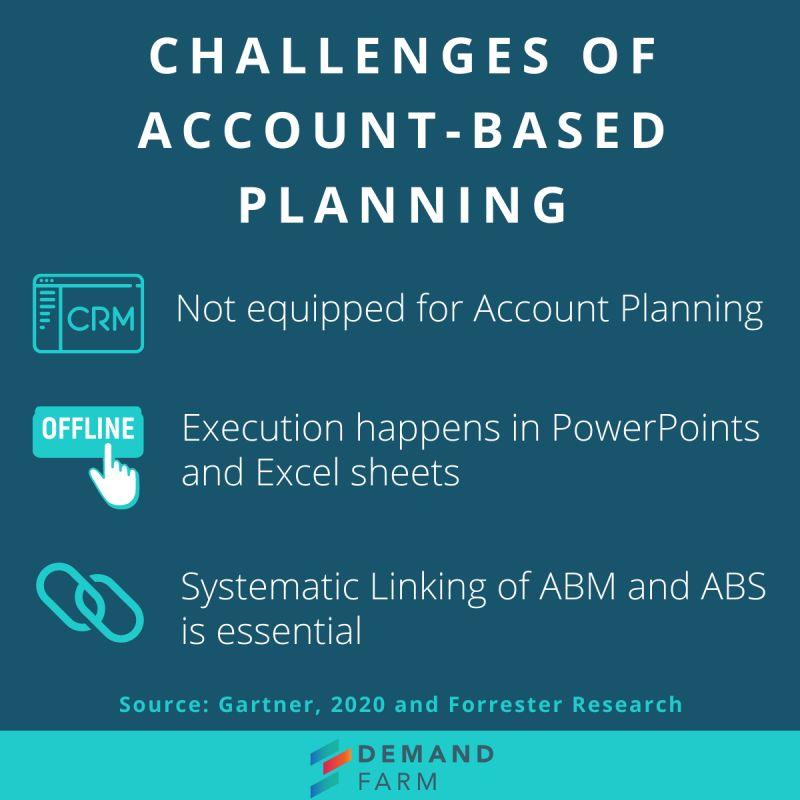
Changing Trends in Account Planning for B2B Sales in 2025
In the last few years, there has been a strategic shift in account management, largely due to the growing role of technology in businesses. These changing trends have had a ripple effect on the process of account planning as well, and it looks very different today vis-à-vis a few years ago. To quote Mr. Ghosh, “Account Planning has changed dramatically from what it was just a few years ago. Technology-led changes in account management have impacted account planning in a big way.
Sales leaders and key account managers (KAMs) in enterprise B2B must pivot to AI-powered, relationship-centric strategies that turn static plans into dynamic, omniscient systems, leveraging unstructured data for 25%+ retention gains.
The future of account planning lies in incorporating these changes. Though the exact shape of account planning in the future remains debatable, it’s certainly going to be more closely related to results and outcomes. Here are some of the key trends in account management and an overview of how they are impacting the account planning process. If companies want to instate effective account planning systems, they will have to take these changes into account.
1. Concentration of Revenue
The Pareto principle (80% of your revenue comes from 20% of your customers) is becoming increasingly relevant for organizations today. Experts believe that it could even become more concentrated than 80/20 in the coming years. Global uncertaineties will continue, new customers will be harder to come by and spend less, while existing customers will grow with you.
With an increasing concentration of revenue, the role of account planning becomes more significant. More importantly, account managers need to recognize that surface-level research is no longer enough. To gain a competitive edge, they need to find innovative ways to gain a more in-depth understanding of the client.
2. AI-Driven Continuous Planning
AI evolves from CRM add-ons to central intelligence hubs synthesizing structured CRM data and unstructured data in meeting transcripts, emails, CPQ pricing for real-time sentiment shifts, and power dynamics mapping. AI copilots enable real-time account scoring, intent tracking, and dynamic plans that update with behavioral data, replacing quarterly reviews with proactive whitespace detection and risk alerts. DemandFarm Kampanion leads by auto-generating monthly account plans from relationship maps, democratizing top-performer strategies.
3. Relationship Intelligence Over Transactions
KAM moves from one-off deals to deep partnerships using AI to track relationship health, spotting sentiment changes, unofficial influencers, and early churn signals like delayed responses. Sales leaders gain health scores and predictive alerts, acting as strategic advisors rather than just sellers.
4. Rise of Specialized KAM Tools vs. CRMs for Account Planning
Enterprise B2B sales leaders increasingly adopt dedicated Key Account Management (KAM) tools over generic CRMs, as CRMs excel at lead acquisition but falter in deep relationship nurturing and proactive planning.
The Role of a Specialized Strategic Account Planning / Management Tool
Specialized KAM tools transform enterprise B2B account management from reactive CRM tracking to proactive, AI-orchestrated growth engines, centralizing intelligence for 25%+ retention and expansion.
Core Capabilities Beyond CRMs
Unlike CRMs focused on leads and pipelines, specialized Account Planning tools deliver 360° account views with relationship maps visualizing influencers, affinities, and power dynamics from unstructured data like emails and calls. AI auto-generates continuous plans, spotting whitespace via heatmaps, predicting churn through health scores, and recommending next actions—eliminating manual QBR prep. Features include executive dashboards, opportunity planners with MEDDIC support, and engagement analytics for stakeholder communication tracking.
Key Benefits of KAM Tools Over CRMs for Account Managers
Account managers gain 30-40% more time for client relationships using specialized Account Planning tools, which provide holistic insights and automation beyond CRM’s transactional focus.
1. Time Savings & Reduced Admin
KAM tools eliminate manual data entry across fragmented systems, auto-enriching accounts with unstructured data from emails, calls, and Gong transcripts, freeing AMs for strategic advisory work. No more “where’s the latest deck?” pings or copy-paste between tools; centralized dashboards deliver real-time client overviews.
2. Deeper Relationship Intelligence
Unlike CRMs treating accounts as “opportunities,” KAM platforms map influencers, track sentiment shifts, and score relationship health to spot unofficial power dynamics and early churn signals. AMs design client-specific goals, monitor progress against mutual objectives, and demonstrate value through personalized hurdles analysis.
3. Proactive Planning & Risk Management
Auto-generated continuous account plans with whitespace heatmaps and predictive alerts uncover 17% more expansion paths, replacing static CRM templates with dynamic strategies. Earlier risk detection turns saves into planned motions, boosting renewals 18-25% via health scores and next-best actions.
4. Enhanced Collaboration & Coaching
Role-based access shares plans securely across sales/CS/marketing, with audit trails and bi-directional CRM sync keeping Salesforce as sales forecast source while KAM becomes daily workflow home. Managers coach via meeting quality insights and stakeholder coverage, improving forecast credibility.
The Future of Account Planning: AI-Powered KAM Coaching for Agility and Depth
The future is laser specialization. KAM needs purpose-built AI-enabled platforms that act as proactive coaches, not passive data stores.
-
Static slide decks? Replace them with dynamic, living account plans that update automatically and deliver real-time insights.
-
Proactive goal tracking? KAM AI keeps tabs on strategic growth objectives, sends you timely reminders, and guides your next best moves with context.
-
Unified intelligence? All your internal CRM data, communication (email, calendar, calls), and external market signals are connected, giving you a factual, 360-degree view of the account.
-
Whitespace discovery? AI analyzes past deals, benchmarks, and broader industry data to identify where growth is possible—visualized in simple heatmaps to guide action.
-
Relationship health? AI turns email and call sentiment into emotional intelligence, mapping influence and detecting emerging risks continuously.
| Aspect | Old Way: Annual Account Planning | New Way: Dynamic AI-Powered Monthly Planning |
|---|---|---|
| Planning Horizon | One-year static plan, created once annually | Rolling monthly plans continuously updated with latest data |
| Strategy Focus | Based on assumptions of market stability | Agile, responsive to fast-changing market and customer needs |
| Data Freshness | Often outdated data by the time plan is executed | Real-time, AI-enriched insights and signals |
| Account Intelligence | Manual research, spread across spreadsheets and decks | Automated research, unified intelligence from external & internal sources |
| Risk and Opportunity Detection | Reactive, annual review of risks and whitespace | Proactive risk detection and whitespace prediction via AI |
| Relationship Management | Static org charts, manually maintained | Dynamic relationship maps with sentiment and engagement analytics |
| Goal Tracking | Basic, manually tracked; often disconnected | AI-driven goal tracking with reminders and actionable guidance |
| Administrative Overhead | High, time-consuming manual effort | Low, majority of research and data entry automated |
| Technology & Tools | Basic CRM features and static templates | Specialized KAM platforms with AI coaching and insights |
| Cost | High, with costly add-ons and high manual effort | Lower, unified platform with significant productivity gains |
| Collaboration and Review | Siloed, periodic reviews and static reporting | Integrated, continuous QBRs with cross-team collaboration |
| Competitive Edge | Limited by static and reactive approach | Enhanced by continuous intelligence and agility |
Talk to an Account Planning expert
If you are wondering what is wrong with today’s account planning and would like to know how certain enterprises are effortlessly building account plans for a thriving business, the secret is an efficient Key Account Management Software that can help overcome dual challenges. The first is that it keeps up with technology-driven trends that are transforming account management as a whole. The other, more complex challenge is that it is clearly aligned with business outcomes, and the progress vis-à-vis these outcomes needs to be tracked over a certain period. Luckily, DemandFarm’s Account Planner makes it much easier to achieve both these goals. So, instead of ignoring or paying lip service to account planning, it’s time to take stock and use the right tools to make the most of this critical process. Talk to an Account Planning Expert today!