

Key account management requires more than a CRM. The tools that move the needle are purpose-built for account planning, relationship intelligence, and renewal and expansion tracking. DemandFarm leads for teams that want structured KAM inside Salesforce or HubSpot. LinkedIn Sales Navigator and Gong complement it well. If you are evaluating dedicated KAM platforms, the DemandFarm key account management software guide goes deeper on platform comparison.
What Should You Look for in Key Account Management Software?
The market conflates CRM tools, sales intelligence tools, and actual KAM platforms. Before comparing products, be clear on what KAM software is supposed to do.
A genuine KAM tool does these things:
- Account planning in one place. Not a shared document. A structured workspace that captures the account strategy, growth plan, stakeholder map, and health score, and keeps it current.
- Relationship intelligence. Your team should know which contacts champion your product, which are neutral, and which are at risk, and they should know it from inside their CRM, not from a separate spreadsheet.
- White space analysis. Identifying where you are not yet selling to a customer is as important as finding new customers. A KAM tool surfaces upsell and cross-sell gaps.
- Renewal and retention tracking. Key accounts are too valuable to lose to poor handoff or lack of engagement. Health scores and renewal signals need to be visible to the entire account team.
- CRM integration. Your KAM tool and your CRM need to talk. Data that lives in a silo gets ignored.
The most common mistake is buying a generic CRM and expecting it to support structured KAM. It will not.
Things to Consider When Choosing Key Account Management Software in 2026
- Does it work inside your CRM or alongside it? Tools that sit inside Salesforce, HubSpot, or Dynamics 365 have much higher adoption than standalone applications. Reps update records they can see. If the KAM tool requires a separate login, it will be underused within three months.
- How does it handle multi-stakeholder accounts? Enterprise accounts have buying committees of 6 to 10 people. Your tool needs to manage relationships across all of them, not just the primary contact.
- Does it support account planning frameworks? MEDDPICC, OGSM, Kite, Force Management: different teams use different frameworks. The best KAM platforms support multiple frameworks or are flexible enough to accommodate your own.
- What does the adoption curve look like? Ask for implementation timelines and user adoption data from references, not just from the vendor. A KAM tool that takes six months to configure and three months for reps to adopt is not delivering value in year one.
- Can RevOps or management see the portfolio without individual access to every account? Visibility at the portfolio level matters. Sales leaders need to see account health, plan quality, and renewal risk across the entire book of business, not account by account.
- How does it handle integrations beyond the CRM? Email, calendar, conversation intelligence, and customer success platforms all generate signals about account health. Look for a tool that surfaces those signals rather than requiring manual data entry.
Comparison at a Glance
| Tool | Primary Use | CRM Native | Account Planning | Price |
|---|---|---|---|---|
| DemandFarm | Full KAM platform | Salesforce, HubSpot, D365, Zoho | Yes | Contact sales |
| LinkedIn Sales Nav | Relationship intelligence | Salesforce, HubSpot | No | From ~$99/month/seat |
| Salesforce Sales Cloud | CRM foundation | Yes | Partial | From $25/user/month |
| OrgChartHub | Org charts | Salesforce, HubSpot | No | [VERIFY AppExchange pricing] |
| ZoomInfo | Sales intelligence | Salesforce, HubSpot, D365 | No | Contact sales |
| Gong | Conversation intelligence | Salesforce, HubSpot | No | Contact sales |
Thats how, the top account management tools in this list compare on primary use, CRM fit, account planning support and pricing.
List of 8 Key Account Management Tools Every Key Account Manager Needs
1. DemandFarm
DemandFarm is built natively for Salesforce and also works with Microsoft Dynamics 365, HubSpot, and Zoho. It is the only platform in this list purpose-built entirely for key account management, rather than adapted from a general CRM or sales engagement tool.
What it does:
- Account planning with MEDDPICC/MEDDIC, OGSM, Kite, and custom frameworks
- Org charts and relationship maps inside the CRM
- White Space Planner for upsell and cross-sell opportunity mapping
- Account health scoring and portfolio dashboard
- Kampanion: AI copilot for key account managers

Pros:
- Purpose-built for key account management; not adapted from a generic CRM
- Works natively with Salesforce and also with HubSpot, Microsoft Dynamics 365, and Zoho
- Full KAM suite in one platform: account plans, org charts, relationship maps, white space, health scoring, and QBRs
- Proven case study results: TaskUs saw a 30% increase in up-selling and 20% in cross-selling; Contentful generated $5M in pipeline and a 15% increase in win rates
Cons:
- Pricing not published; requires a sales conversation
- Better suited to teams with a formal account planning programme than those doing informal key account tracking
- Requires some configuration to set up frameworks and templates
The need for it
B2B companies use DemandFarm to simplify key account management and make it predictable and scalable. Here are the pain points it addresses:
– Systemize whitespacing through a visual representation of customers’ buying centers vs your offerings
– Prevent the risk of losing important account knowledge and thereby the account itself
– Gain better visibility of your growth/expansion opportunities by pulling in data from multiple apps in one place
– Eliminate blindspots in key account relationships and let account managers spend 100% of their time on the right contacts
– Makes account planning dynamic, proactive & real-time, so that you can track growth & course-correct on the fly
See DemandFarm in Action
2. LinkedIn Sales Navigator
Sales Navigator is not a KAM platform. It is the best prospecting and relationship intelligence layer you can add to one. For key account managers, the most valuable features are account alerts (job changes, company news, new hires) and the ability to identify new contacts at existing accounts.
What it does:
- Real-time alerts when contacts change roles or leave accounts
- Contact discovery within existing accounts
- Relationship mapping through shared connections and TeamLink
- Integration with Salesforce and HubSpot (syncs contacts and account data)
Pros:
- Best tool for contact discovery and relationship intelligence at existing accounts
- Real-time alerts when contacts change roles, companies, or titles
- TeamLink surfaces warm introduction paths through shared connections
- Integrates with Salesforce and HubSpot
Cons:
- Not a KAM platform; no account planning, white space analysis, or health scoring
- Expensive for large teams; pricing from approximately $99 per seat per month [VERIFY current Sales Navigator pricing]
- Data limited to LinkedIn network and activity only
3. Salesforce Sales Cloud (with Account Planning)
Salesforce on its own is a CRM, not a KAM tool. But for teams that have heavily customised Salesforce, or that use the built-in account hierarchy and opportunity management features, it serves as the foundation that KAM tools (like DemandFarm) are built on top of.
What it does natively:
- Account and contact hierarchy management
- Opportunity tracking and pipeline management
- Buyer Relationship Map (built-in in recent editions)
- Activity capture from email and calendar
What it does not do natively: Structured account planning, white space analysis, relationship health scoring, or portfolio-level KAM dashboards. Those require an add-on like DemandFarm.
Pros:
- CRM foundation that all other KAM tools are built on
- Account and contact hierarchy management out of the box
- Built-in Buyer Relationship Map available in recent editions
- Activity capture from email and calendar
Cons:
- Not a KAM tool; no structured account planning, white space, or relationship health scoring natively
- Requires an add-on like DemandFarm for genuine KAM functionality
- Custom-building KAM features inside Salesforce is expensive and time-consuming
Salesforce Account Plans Explained in Detail
4. OrgChartHub
OrgChartHub is a standalone org chart tool that integrates with Salesforce and HubSpot. It is simpler than DemandFarm or ARPEDIO: it builds and maintains org charts but does not include account planning features.
What it does:
- Visual org charts linked to CRM contact records
- Drag-and-drop chart builder
- Relationship mapping for buying committees
- Import/export from Salesforce or HubSpot
Pros:
- Lightweight; works with Salesforce and HubSpot
- Drag-and-drop chart builder with auto-generation from CRM data
- Simple to set up
Cons:
- Org charts only; no account planning, white space, or health scoring
- Does not offer relationship intelligence or sentiment tracking
- Pricing requires verification
5. ZoomInfo
ZoomInfo is a sales intelligence platform, not a KAM tool. Its value for key account managers is contact data accuracy, buying signal detection, and identifying new stakeholders at existing accounts.
What it does:
- Company and contact database with verified information
- Intent signals for existing and prospect accounts
- Integration with Salesforce, HubSpot, and Dynamics 365
- Org chart data and reporting relationship information
Pros:
- Verified contact data with intent signals for existing accounts
- Org chart data and reporting relationship information
- Integrates with Salesforce, HubSpot, and Dynamics 365
Cons:
- Not a KAM tool; no account planning, relationship mapping, or health scoring
- Expensive at scale; pricing on request
- Data accuracy varies by market and region
6. Gong
Gong is a revenue intelligence platform that captures and analyzes sales conversations across calls, meetings, and emails. It applies AI and natural language processing to extract actionable insights, enabling sales and account management teams to improve performance and forecast accuracy.
What it does
Gong automatically records and transcribes conversations, then analyzes talk patterns, sentiment, competitive mentions, and key buyer signals. For account managers, this means deep visibility into the nuances of customer interactions without relying solely on manual CRM data entry. Gong highlights engagement trends, identifies opportunity risks, and surfaces coaching moments, helping account teams focus on deals and relationships that matter most. Its integration with CRMs like Salesforce allows these insights to flow seamlessly into existing workflows. Unlike static tools, Gong’s AI continually monitors conversations to detect account health changes, risks, and new upsell or cross-sell opportunities proactively.
The need for it
In key account management, understanding relationship power dynamics, sentiment, and influence is critical. Tools like DemandFarm leverage Gong data to map influences, power, affinity, and sentiment automatically in relationship maps and generate risk alerts for accounts and opportunities, Gong uniquely analyzes the actual conversational data fueling those relationships. This conversation-level intelligence equips account managers to engage more effectively and act on early warning signs of churn or deal shifts. Gong and DemandFarm thus complement each other, Gong providing AI-powered conversation insights while platforms like DemandFarm focus on relationship visualization and strategic account planning.
7. CRMs
Customer Relationship Management (CRM) tools like MS Dynamics, Pipedrive, Zoho, Hubspot or Salesforce are widely used by sales and account mgmt teams to centralize customer data, track interactions, and manage pipelines. They form the backbone of organizations’ sales operations.
What it does
An account management CRM collects and stores detailed account information, logs communications, automates workflows and generates reports. They help teams collaborate by providing visibility into client history and sales activities. For account managers, CRMs offer essential capabilities such as contact management, deal tracking, task automation, and integration with other sales tools.
The need for it
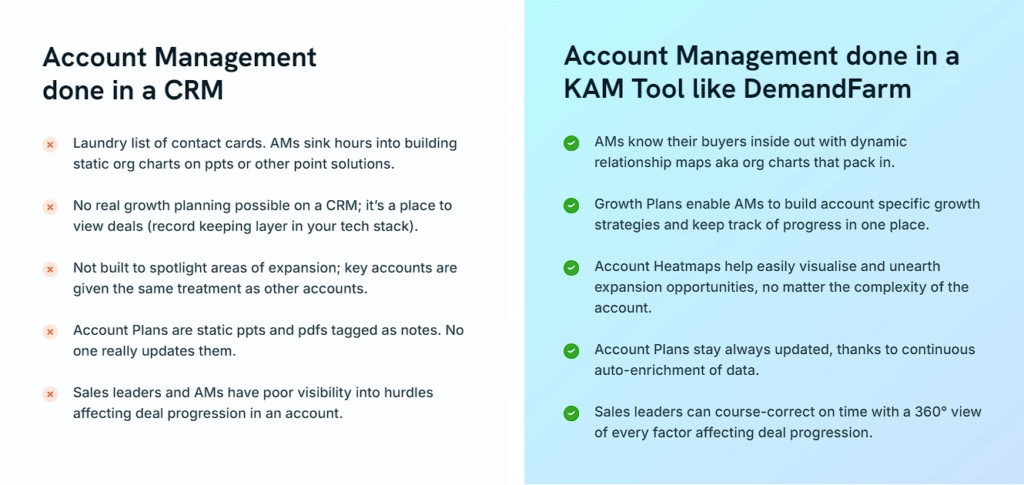
While essential for day-to-day account management, CRMs fall short for strategic key account needs. They typically lack capabilities like dynamic relationship mapping, real-time risk alerts, whitespace identification, and AI-powered guidance. CRMs often focus on transaction-level data and miss the broader, multi-dimensional insights required to grow complex accounts effectively.
Specialized KAM platforms like DemandFarm fill these gaps. They offer richer, proactive insights and tailored workflows that enable account managers to deepen relationships, identify risks early, and drive sustained account growth in areas where traditional CRMs struggle to deliver. This makes relying solely on CRMs limiting for advancing key account programs.
8. AI Assistants
AI GPT tools like Google Gemini, ChatGPT, and Perplexity are advanced language models designed to understand and generate human-like text, offering powerful conversational and research capabilities.
What it does
They assist account managers by providing quick answers, generating content, and synthesizing information from multiple sources. Gemini excels in handling large, multimodal data with deep context retention, ChatGPT offers versatile, creative conversation and content generation, while Perplexity provides fast, fact-based answers with real-time web search integration.
The need for it
Account managers use these tools to speed up research, brainstorm strategies, and enhance communication. However, because these GPTs aren’t directly integrated into sales tech stacks, their responses lack the specialization and real-time relevance needed for key account management. Critical tasks like prioritizing opportunities or identifying key contacts require specialized AI.
DemandFarm’s KAMpanion fills this gap with instant relationship mapping, AI-powered deep research, proactive risk alerts, and strategic growth guidance tailored specifically to key accounts, capabilities that GPT tools alone do not fully provide. This specialist focus is essential for transforming AI insights into actionable account management outcomes.
Words to leave by
Key account management (KAM) is essential for focusing on high-value clients to foster long-term loyalty, increase revenue, and reduce churn. By understanding each client’s unique needs, companies can tailor strategies that maximize growth and retention. However, traditional approaches often lack the automation, insights, and relationship depth needed in today’s complex market environments. Advanced tools like DemandFarm or specialized AI platforms are crucial to overcoming these limitations, providing real-time relationship mapping, proactive risk alerts, and data-driven growth strategies for true strategic partnership.
Frequently Asked Questions (FAQ)
What is the difference between a CRM and key account management software? A CRM records contacts, deals, and activities. Key account management software structures how you manage your most important customers: account plans, relationship maps, health scores, and white space analysis. CRMs rarely include these features. KAM tools like DemandFarm sit inside your CRM and add that layer.
Do I need a dedicated KAM tool if I already have Salesforce? Salesforce provides the data foundation but not the account planning structure. Teams that rely solely on Salesforce typically manage account plans in PowerPoint or Google Docs, which gets outdated fast and is invisible to management. A dedicated KAM tool inside Salesforce solves both problems.
How many key accounts can a team manage without dedicated software? A rule of thumb: five or fewer key accounts per rep, managed with a CRM and a shared document, can work informally. Above that, without a structured tool, account plan quality and data accuracy both decline quickly.
What integrations should I look for in a KAM tool? At minimum: your CRM (Salesforce, HubSpot, Dynamics 365, or Zoho), email and calendar for activity capture, and conversation intelligence (Gong, Chorus, or similar). The more signals your KAM tool can pull in automatically, the less manual work reps need to do.
Is key account management software worth the cost for mid-market teams? If you have a named account programme, yes. The break-even point is typically one retained key account or one expansion deal per year that would have been lost without better visibility. For most mid-market B2B teams, that threshold is low.
What Next?
If you are comparing dedicated KAM platforms head to head, see the full key account management software guide for a platform comparison, what to ask vendors, and how to build the business case.
Get Started with DemandFarm
DemandFarm is the only platform in this list built entirely for key account management. Native to Salesforce, it also works with HubSpot, Microsoft Dynamics 365, and Zoho.