


Did you know?
 Here’s how businesses can benefit from using AI in large enterprise resource planning.
- The global AI market is valued at over USD $136 billion
- By 2025, as many as 97 million people will work in the AI space
- 48% of businesses use some form of AI to use big data effectively
- 83% of companies claim that AI is top priority in their business plans
- AI industry value is projected to increase over 13x over the next 7 years
- Netflix makes USD $1 billion annually from automated personalized recommendations
Read More: Analysts’ Predictions of AI for Sales, Account Management and Sales Enablement in 2023
Benefits of AI in Large Enterprise Account Planning
AI technology offers a range of advanced benefits for large enterprise account planning. With the help of the modern tools and techniques that AI employs, businesses can gain deeper customer insights, optimize their account plans, and make better strategic decisions.
Here’s how businesses can benefit from using AI in large enterprise resource planning.
1. Enhanced insights and data analysis
AI can help businesses analyze large amounts of customer data with speed and identify patterns and trends. Using traditional data analysis techniques to perform these same tasks would be time-consuming and difficult. For example, machine learning algorithms can identify the most relevant customer attributes and predict which customers are most likely to make a new purchase or renew a contract. Businesses can gain a competitive edge and optimize their account plans more effectively through the use of advanced data analysis tools.2. Improved efficiency and productivity
Through the use of AI, many routine tasks and processes involved in account planning can be automated. This frees up time for sales and account management teams to focus on more strategic activities. For example, natural language processing (NLP) tools can analyze customer interactions and identify potential upsell and cross-sell opportunities. Also, automated lead generation tools can identify new potential customers using predefined criteria. By using these tools, businesses can improve their efficiency and productivity, thus ensuring that they achieve revenue goals more effectively.3. Streamlined collaboration and communication
Project management tools powered by AI are useful in helping teams collaborate more effectively and communicate more efficiently. Team members can have access to a centralized platform to access and share information. Workflows can be streamlined to ensure that everyone is working towards shared business goals. Advances virtual meeting tools can also be used to facilitate real-time communication and enable remote collaboration. This level of connection and accessibility has a positive effect on team productivity. It also reduces the time and costs associated with travel and in-person meetings.4. Better risk management and decision-making
By providing real-time insights into key performance indicators (KPIs) and identifying potential risks, AI can assist businesses in making more informed decisions. For example, network analysis tools can help companies identify potential risks in their supply chain and even predict when a supplier may become unreliable. Predictive analytics can help businesses anticipate market shifts and adjust strategies accordingly, minimizing the risk of lost revenue and possible damage to their reputations.5. Increased accuracy and reliability
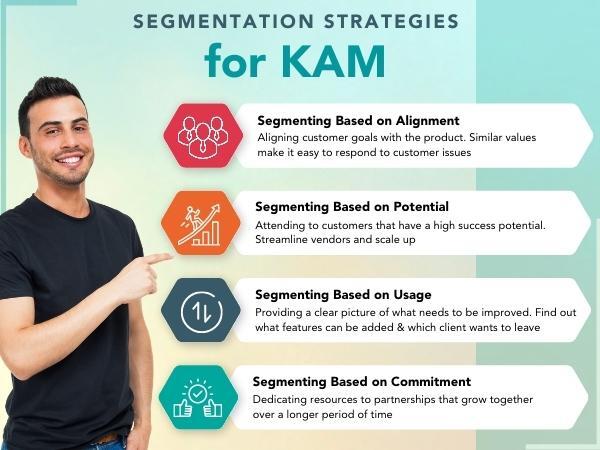
Companies are always looking to identify their high-value customers and tailor their account plans accordingly. Working with AI-powered customer segmentation tools, this task is so much easier. These tools help businesses to segment customers based on a variety of attributes, such as demographics, purchase history, and engagement metrics. Advanced data analysis tools can also help businesses track the performance of their account plans. This data can then be used to develop and adjust their plans and strategies. Even as businesses gain a competitive edge and can effectively optimize their account planning through AI tools and techniques, it is important to note that there are challenges and limitations. These include data privacy concerns and the need for expertise in implementing and maintaining AI systems. Businesses that can overcome these challenges and utilize AI to its maximum potential in account planning will see significant benefits and achieve long-term growth and success.AI Tools and Techniques for Large Enterprise Account Planning
AI has been able to effectively use the best and most advanced tools and techniques. Employing AI, therefore, gives companies deeper insights which help them drive growth. Some of the most popular AI tools and techniques used in large enterprise planning are:1. Predictive analysis and Forecasting
These are powerful AI tools to help businesses predict future trends and outcomes based on past data. By analyzing data from various sources like customer behavior, market trends and sales performance, predictive analysis algorithms can provide accurate forecasts. Businesses can use these reports to make well-informed decisions about resource allocation, budgeting and sales strategy.
2. Natural Language Processing (NLP) and Sentiment analysis
These techniques enable businesses to analyze and understand customer feedback and sentiment in real-time. Companies receive valuable insights into customer behaviour, preferences and pain points. This is done by NLP algorithms which analyze customer reviews, comments and social media activity. The information can be used to improve customer experience, develop targeted marketing campaigns, and optimize sales strategies.3. Customer segmentation and targeting
Through these AI techniques businesses are better able to identify and target specific customer groups based on their unique characteristics and behavior. Customer data line demographics, buying behavior, and online activity are studied and reported. Through these reports, businesses can personalize marketing strategies and sales campaigns – tailored to the needs and preferences of different customer segments. Benefits to businesses include improved customer engagement, increased sales and brand loyalty.
4. Relationship mapping and Network analysis
Businesses can identify and analyze relationships between different entities such as customers, partners, and suppliers through the use of relationship mapping and network analysis. Data is tracked from various sources like social media, email, and other online activity and analyzed. Through this analysis, relationship mapping algorithms can help businesses identify key influencers, decision-makers and potential partners. This information can therefore be used to improve collaboration, strengthen business relationships and increase sales and revenue.5. Sales automation and Lead generation
Companies that are looking to automate repetitive sales tasks and generate new leads more efficiently will benefit from sales automation and lead generation. AI-powered tools like chatbots and virtual assistants help businesses engage with customers and prospects in real-time. They can be programmed to answer commonly asked questions and offer personalized recommendations. This helps increase sales, improve customer experience and reduce sales cycle times.Challenges and Considerations for AI Implementation
While AI offers numerous benefits to large enterprise account planning, the process also includes several challenges. Following are some of the most significant challenges and considerations to be taken into account when implementing AI.1. Data quality and integration:
Ensuring that data quality and integration are up to par is one of the biggest challenges in AI implementation. When data is incomplete, inaccurate or inconsistent, it significantly reduces the effectiveness of AI. The integration of different data sources can also be complex and time-consuming.2. Ethical and legal concerns:
These concerns arise because AI technologies often require sensitive data to be collected and analyzed. It is therefore important to ensure that AI implementations meet the relevant standards of legal and ethical compliance, such as privacy regulations and ethical AI principles.3. Cultural issues and resistance to change:
The introduction of AI to large enterprise account planning can require significant changes in work processes and cultural norms. If there is resistance to change, AI implementation can be severely impacted. Communicating the benefits of AI and involving stakeholders in the implementation process increases the possibility of successful AI implementation.4. Skill gaps and lack of resources:
Implementing AI required specialized skills and resource persons, like data scientists and AI engineers. With skills in short supply and the high costs of hiring and training, this can be a major hurdle.5. Maintenance and optimization:
To ensure that it continues providing value over time AI requires ongoing maintenance and optimization. This includes regular updates to the algorithms, monitoring performance and improving integration with other systems and apps in use.Case Studies and Examples of Successful AI Implementation
In recent years, there has been an increase in AI adoption for large enterprise account planning, with many industry leaders and innovators paving the way for successful implementation. The following are real-world examples of how AI has been used to transform large enterprise account planning.Real-world applications and outcomes
- IBM Watson has been employed at large enterprises to analyze large amounts of customer data to discover patterns and trends that would’ve been difficult to identify manually.
- Intel has used AI in its account planning process to improve forecasting accuracy and identify new sales opportunities.
Lessons learnt and best practices
- Start small: There’s always room to scale up: Most successful implementations begin with a small pilot program, which can be scaled up when the desired results and benefits are demonstrated.
- Focus on data quality: For successful AI implementation, the quality of data and the success of integration are critically important. Investing in data quality and management at the outset might involve an initial outlay, but can help avoid costly issues later in the process.
Potential for future growth and expansion
- There is a vast amount of potential for AI in large enterprise account planning, with new applications and use cases constantly emerging. AI technology will continue to improve and with it will increase its potential to revolutionize how large enterprises approach account planning and drive growth.